LATE BLIGHT IN THE FARM: HOW TO IDENTIFY, PREVENT AND MANAGE IT
By CHETU AGROSOLUTION · 29 September 2026
Farmer, healthy crops are the foundation of good yields. When we talk about crop diseases, some diseases can start with only a few symptoms but spread rapidly and cause significant losses if the farmer does not identify the problem early.
One of these challenges is late blight, a disease that commonly affects crops such as tomatoes and potatoes. It is associated with the pathogen Phytophthora infestans and can spread rapidly, especially under conditions of high humidity, rainfall, heavy dew, and favorable weather conditions.
At CHETU AGROSOLUTION, we advise farmers not to wait until the entire field begins to wilt. We want you to learn how to recognize the symptoms early, understand the conditions that encourage the disease, and take appropriate action on time.
1. WHAT IS LATE BLIGHT?
Late blight is a disease that can affect tomato and potato leaves, stems, fruits, and potato tubers.
Unlike some diseases that begin slowly on lower leaves and progress gradually, late blight can spread very quickly when favorable environmental conditions are present.
Therefore, if you notice unusual spots on leaves during periods of high humidity, rainfall, or heavy dew, we advise you not to ignore them.
Do not simply say, “The leaves are getting old.”
Inspect them first.
2. SYMPTOMS OF LATE BLIGHT
Farmer, one of the most important steps is learning how to recognize the symptoms.
Symptoms on leaves
You may notice:
Large, irregularly shaped spots on the leaves.
Spots that initially have a water-soaked appearance.
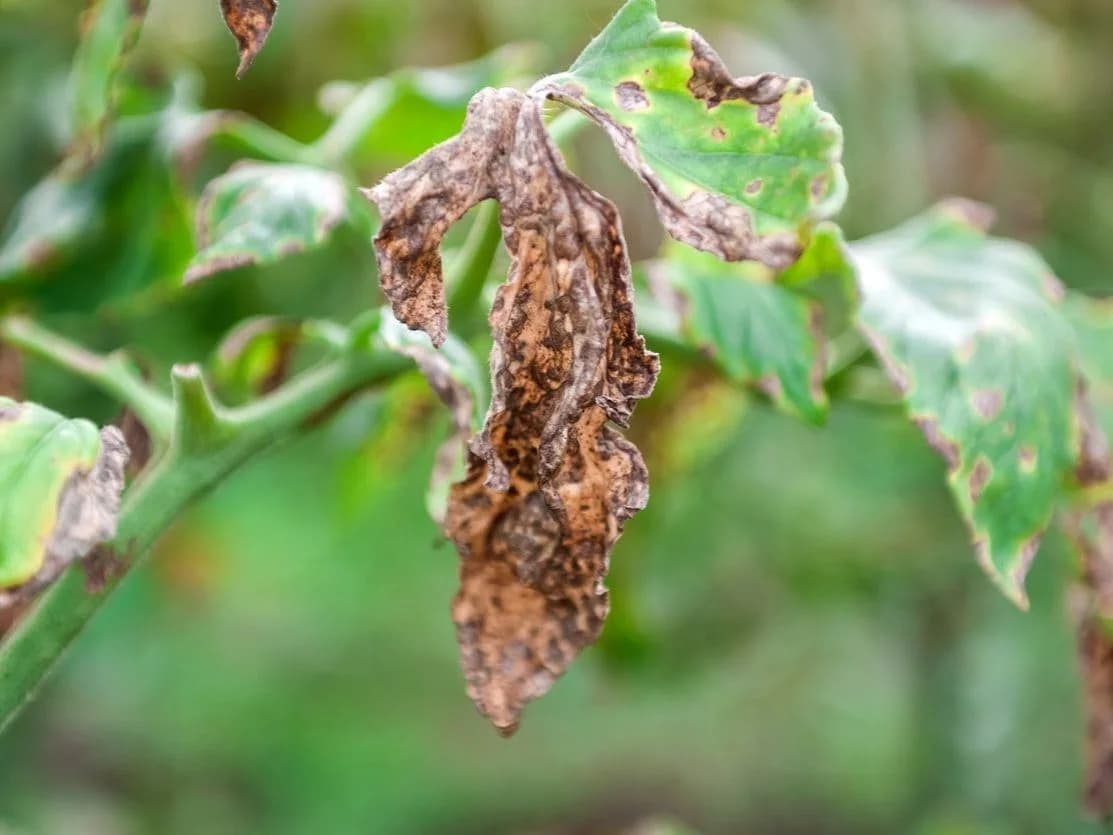
The spots may begin as greenish-grey or olive-colored areas and later become brown to black.
Spots may merge and destroy large portions of the leaf.
Leaves may dry out and shrivel.
As the disease progresses, the plant may appear as though it has been damaged by frost or burned.
Under high-humidity conditions, you may also notice a whitish, mold-like growth on affected areas, especially on the underside of leaves.
Symptoms on stems
Late blight may also appear on stems as:
Brown or black lesions.
Dark or damaged areas on the stem.
Weakening of affected sections.
Disease progression from leaves to petioles and stems.
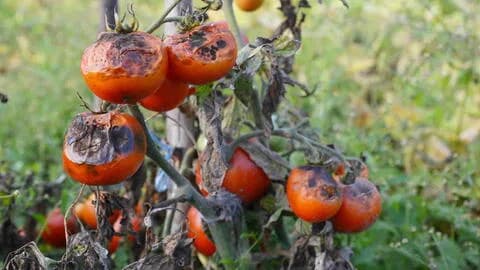
Symptoms on tomato fruits
Tomato farmers should also pay close attention to the fruits.
You may notice:
Brown or olive-colored spots.
Spots that spread and cover larger portions of the fruit.
Fruits may begin to rot, particularly when secondary organisms invade damaged tissue.
Both green and ripe tomatoes can be affected.
Symptoms on potatoes
In potatoes, the disease can affect foliage above the ground and also the tubers below the soil.
Affected tubers may show discoloration and rotting, particularly when infection is severe.
3. WHY IS LATE BLIGHT DANGEROUS?
We want to emphasize this to every farmer:
Do not wait until many plants are affected before taking action.
Late blight can spread very quickly when environmental conditions are favorable.
Under cool and humid conditions, the pathogen can produce structures that help infections spread from one plant to another.
This is why a field may appear healthy today, but shortly afterward you may begin seeing large areas with dead or damaged leaves.
4. RAINFALL AND HUMIDITY ARE IMPORTANT DRIVERS
Farmer, we advise you to pay close attention to the conditions in your field.
Late blight is favored by conditions such as:
Frequent rainfall.
Heavy dew.
High humidity.
Leaves remaining wet for long periods.
Poor air circulation.
Overcrowded plants.
Cool and humid weather can increase disease risk and accelerate its spread.
Therefore, do not look at the disease alone; also look at the environment surrounding the crop.
5. DO NOT CONFUSE LATE BLIGHT WITH EVERY LEAF DISEASE
This is something we strongly emphasize at CHETU AGROSOLUTION.
Not every leaf with spots has late blight.
Tomatoes and potatoes can also be affected by other problems such as:
Early blight.
Septoria leaf spot.
Bacterial diseases.
Viral diseases.
Nutrient deficiencies.
Water stress.
Sunscald.
Insect damage.
For example, early blight often produces circular spots with concentric rings resembling a target, while late blight commonly produces larger, irregularly shaped lesions that may have a water-soaked appearance.
Therefore:
Do not buy a pesticide simply because you see spots on the leaves.
Identify the problem first.
6. OUR ADVICE: SCOUT YOUR FIELD REGULARLY
We advise farmers to establish a regular scouting routine, meaning systematic inspection of the crop.
Do not wait until:
Many leaves have dried.
Plants begin collapsing.
Fruits start rotting.
The entire field shows symptoms.
Walk through the field and inspect:
Lower leaves.
Middle leaves.
Young leaves.
Stems.
Fruits.
Areas with higher moisture.
Shaded areas.
Areas with poor air circulation.
When environmental conditions favor disease development, regular scouting is important because early detection allows the farmer to plan appropriate management actions in time.
7. MAINTAIN APPROPRIATE PLANT SPACING
Farmer, do not overcrowd plants simply because you want to fit more plants into a small area.
Overcrowded plants:
Reduce air circulation.
Cause leaves to remain wet for longer.
Increase humidity within the crop canopy.
Create conditions that may favor disease development.
We advise you to follow the recommended spacing for your crop and variety.
Do not take the spacing used for one crop and apply it to another crop.
8. MANAGE WATER PROPERLY
Water is essential for crop growth, but poor water management can create conditions that favor leaf diseases.
We advise you to:
Avoid excessive irrigation.
Do not irrigate simply out of habit without checking soil moisture and crop needs.
Where possible, use irrigation methods that reduce direct wetting of the leaves.
If overhead irrigation is used, schedule it in a way that allows leaves to dry as quickly as possible.
Ensure that the field has good drainage.
Drip irrigation or other irrigation methods that deliver water close to the root zone can reduce leaf wetness compared with methods that directly wet the crop canopy.
9. DO NOT ALLOW WEEDS TO TAKE OVER THE FIELD
Farmer, weeds are not a problem only because they compete with crops for water and nutrients.
A field with excessive weeds can also:
Reduce air movement.
Increase humidity.
Make crop inspection difficult.
Provide environments for certain pests and diseases.
Therefore, we advise you to control weeds on time and use a method appropriate for your crop.
10. USE QUALITY SEEDS AND HEALTHY PLANTING MATERIAL
Farmer, do not start the season by selecting seeds without considering their quality and source.
For potatoes, the source of seed is particularly important because infected seed tubers can contribute to disease problems.
For tomatoes, we advise you to select healthy seedlings and inspect them carefully before transplanting them into the field.
Where varieties with disease resistance or tolerance are available, you may consider them according to your location, season, production system, and professional advice.
However, remember:
A disease-resistant variety does not mean a variety that can never become infected.
Resistant or tolerant varieties may still develop disease when disease pressure and environmental conditions are favorable.
11. REMOVE SOURCES OF INFECTION
Farmer, do not leave severely diseased plants in the field without a management plan.
Infected plant residues can contribute to continued disease problems depending on the production system and environmental conditions.
We advise you to:
Remove severely affected plants using an appropriate method.
Remove crop residues after harvest.
Avoid leaving rotting potatoes or infected crop residues in the field.
Manage volunteer potatoes and volunteer tomatoes.
Clean tools that may carry infected plant material.
For late blight of tomatoes and potatoes, management of volunteer plants and infected crop residues can be part of an integrated strategy to reduce sources of infection.
12. AVOID UNNECESSARY FIELD WORK WHEN PLANTS ARE WET
Farmer, we advise you to plan field operations according to moisture conditions.
Avoid unnecessary movement through wet crops when plants are covered with rain or heavy dew, particularly when dealing with diseased plants.
Pruning and cutting tools should also be properly cleaned after handling diseased plants.
13. DO NOT RUSH TO USE PESTICIDES WITHOUT IDENTIFYING THE PROBLEM
This is one of the mistakes we frequently see among farmers.
A farmer sees spots on leaves and immediately goes to purchase any fungicide.
This is not the right approach.
Late blight is caused by Phytophthora infestans, which belongs to a group known as oomycetes or water molds, rather than true fungi, although its management commonly involves products referred to as fungicides.
Therefore, we advise you to follow this approach:
Identify the problem → choose a management strategy → select an appropriate registered product → use it according to the label.
14. CHOOSE PRODUCTS ACCORDING TO THE ACTUAL PROBLEM
At CHETU AGROSOLUTION, we do not want farmers to purchase agricultural inputs through guesswork.
If late blight is suspected, we need to consider:
What crop are you growing?
Which variety are you growing?
How old are the plants?
When did the symptoms begin?
Are symptoms only on leaves or also on stems?
Are the fruits affected?
How humid is the field?
How much rainfall has occurred?
How quickly is the disease spreading?
Which products have already been used?
How many applications have been made?
What is the field history?
These details help us understand the problem before recommending appropriate agricultural inputs.
15. DO NOT REPEATEDLY USE THE SAME PRODUCT WITHOUT A MANAGEMENT PLAN
Incorrect pesticide use can contribute to reduced effectiveness against certain pathogens.
Therefore, we advise farmers to:
Do not repeat a product without following its label.
Do not change the recommended dosage through guesswork.
Do not mix products indiscriminately.
Follow the recommended interval between applications.
Observe the required pre-harvest interval.
Where appropriate, rotate fungicide groups as part of a proper resistance-management program.
Professional late blight management recommendations also emphasize correct product use, appropriate application timing, and rotation of fungicide groups to reduce the risk of resistance.
Do not increase the dosage simply because the disease appears severe.
Follow the product label and professional advice.
16. PREVENTION IS BETTER THAN WAITING UNTIL THE DISEASE BECOMES SEVERE
Farmer, with late blight we strongly emphasize prevention and early management.
Do not wait until the entire field is affected.
In locations and seasons where conditions favor the disease, management programs may need to begin early or when initial symptoms are detected, depending on the crop, registered product, weather conditions, and professional recommendations.
This is why we advise you to have a plan for:
Before planting → during planting → during crop growth → during rainy periods → during harvest.
17. DO NOT FORGET SOIL HEALTH AND CROP NUTRITION
Farmer, a healthy crop with balanced nutrition has a better foundation for growth and resilience than a crop growing under severe nutritional stress.
However, we want to emphasize:
Fertilizer is not a cure for late blight.
Do not apply additional fertilizer simply because the crop is showing disease symptoms without understanding the underlying problem. You may increase production costs without solving the actual cause.
We advise you to:
Test your soil where possible.
Develop an appropriate crop nutrition plan.
Use nitrogen, phosphorus, and potassium according to crop requirements.
Manage irrigation properly.
Protect root health.
Monitor crop development.
18. INSPECT THE ENTIRE FIELD
Do not inspect only one plant.
We advise you to determine whether:
The problem is limited to a few plants:
Investigate the source and take measures to prevent further spread.
The problem is concentrated in one area:
Check whether that area has:
Excess water.
Shade.
Poor air circulation.
Poor drainage.
A history of disease.
The problem is widespread across the field:
Investigate weather conditions, seedling or seed sources, field history, and possible routes of disease spread.
This is why we advise farmers not to make decisions based on one leaf alone.
19. DIFFERENCE BETWEEN LATE BLIGHT AND WATER SHORTAGE
Farmer, a wilting plant does not automatically mean that it lacks water.
A plant can wilt or become weak because of:
Disease.
Root disease.
Root rot.
Water shortage.
Excess water.
High temperatures.
Root damage.
Insect damage.
Bacterial or viral diseases.
Late blight itself can cause large portions of the foliage to become brown and die as the disease progresses.
Therefore, do not simply add water every time you see a weak or wilting plant. Investigate first.
20. DO NOT WAIT UNTIL THE FRUITS START ROTTING
For tomato farmers, losing leaves is not a minor problem.
Leaves are essential for producing food through photosynthesis.
When disease becomes severe and causes large amounts of foliage to die, the crop may struggle to maintain healthy growth and fruit production, while the fruits themselves can also become affected.
Late blight can affect tomato leaves, stems, and fruits, as well as potato foliage and tubers.
Therefore, we advise you:
Do not wait until the symptoms reach the fruits before taking action.
21. WHAT TO DO WHEN YOU NOTICE SYMPTOMS
Farmer, if you see symptoms that resemble late blight:
Step One:
Stop and inspect.
Do not immediately spray an unknown product.
Step Two:
Identify the symptoms.
Check the leaves, stems, and fruits.
Step Three:
Check the weather conditions.
Rain? Dew? High humidity? Poor air circulation?
Step Four:
Assess the extent of the problem.
Is it affecting a few plants or a large part of the field?
Step Five:
Separate or remove severely affected plants where appropriate.
Step Six:
Seek professional advice.
This is where we at CHETU AGROSOLUTION can help you.
22. HOW DOES CHETU AGROSOLUTION HELP YOU?
Farmer, we do not want you to come to us simply asking:
“Give me a pesticide for late blight.”
We want you to come to us with information about your field so that we can help you understand the challenge.
At CHETU AGROSOLUTION, we help farmers with:
Access to suitable seeds.
Access to agricultural inputs.
Advice on the correct use of agricultural inputs.
Identification and understanding of crop challenges.
Crop nutrition advice.
Pest and disease management advice.
Crop management plans according to crop growth stages.
Farm monitoring where such services are required.
We want the farmer to receive a solution to the problem, not simply a product.
23. WHEN CONTACTING US, PROVIDE THESE DETAILS
To help us advise you more effectively, we recommend that you tell us:
What crop are you growing?
Which variety are you using?
How old is the crop?
When did you plant or transplant?
Where is the farm located?
Are you using irrigation or relying on rainfall?
When did the symptoms begin?
Which part of the plant showed symptoms first?
How quickly are the symptoms spreading?
Which fertilizers have you used?
Which crop-protection products have you used?
How many applications have you made?
How has the rainfall been?
Is the problem affecting a few plants or a large part of the field?
If you have clear photos of affected plants, you can also send them to us for an initial assessment, although photographs alone cannot always confirm a disease diagnosis.
24. FARMER MISTAKES YOU SHOULD AVOID
We advise you to avoid:
❌ Waiting until the disease becomes severe.
❌ Buying pesticides without identifying the problem.
❌ Mixing pesticides indiscriminately.
❌ Increasing the dosage through guesswork.
❌ Using a pesticide simply because a neighboring farmer used it.
❌ Wetting the foliage unnecessarily.
❌ Allowing the field to become overgrown with weeds.
❌ Overcrowding plants.
❌ Leaving diseased crop residues in the field.
❌ Ignoring the history of the field.
❌ Using poor-quality or unreliable seeds/seedlings.
❌ Repeatedly using the same product without a proper resistance-management plan.
Farmer, modern farming is not about guesswork. It is about observing, planning, implementing, and monitoring.
25. THE CHETU AGROSOLUTION APPROACH FOR FARMERS
We want every farmer to follow this system:
BEFORE PLANTING
Select appropriate seeds.
Prepare the field properly.
Conduct soil testing where possible.
Plan crop nutrition.
Plan irrigation.
Develop a crop-protection strategy.
DURING PLANTING
Use healthy seeds or seedlings.
Follow appropriate spacing.
Ensure good drainage.
Avoid conditions that can create excessive moisture.
DURING CROP GROWTH
Inspect the field regularly.
Control weeds.
Manage water properly.
Monitor disease symptoms.
Monitor pests.
Manage crop nutrition.
DURING RAINY AND HUMID PERIODS
Increase field monitoring.
Inspect leaves regularly.
Do not ignore unusual leaf spots.
Take appropriate action once the problem has been identified.
AFTER HARVEST
Remove diseased crop residues appropriately.
Manage volunteer plants.
Clean farm equipment.
Plan crop rotation for the next season.
26. OUR ADVICE TO TOMATO AND POTATO FARMERS
Farmer, if you grow tomatoes or potatoes, we want you to be particularly careful during periods when conditions favor late blight.
Do not wait until many plants have dried before taking action.
We advise you to establish a regular field-inspection routine and be prepared to take appropriate action according to crop conditions, weather conditions, and professional advice.
Remember that late blight can spread rapidly when conditions are favorable.
27. LATE BLIGHT IS NOT A “PESTICIDE-ONLY” PROBLEM
We want you to understand this clearly.
If you try to manage late blight only by spraying products while ignoring:
Poor water management,
Overcrowded plants,
Weeds,
Diseased crop residues,
Poor-quality seeds or seedlings,
Inadequate field scouting,
Field history,
then important parts of the problem remain unaddressed.
That is why we at CHETU AGROSOLUTION emphasize Integrated Crop Management — combining quality seeds, proper field management, crop nutrition, water management, field sanitation, regular monitoring, and appropriate crop-protection products when necessary.
28. FINAL ADVICE FROM CHETU AGROSOLUTION
Farmer, do not fear the disease.
Understand the disease.
Do not fear the rain.
Learn how to manage your field during rainy conditions.
Do not rush to use pesticides.
Identify the problem first.
Do not wait until many plants are affected.
Start monitoring early.
Above all:
DO NOT FARM BY GUESSWORK.
We at CHETU AGROSOLUTION are here to support you throughout your farming journey — from selecting the right seeds, obtaining agricultural inputs, managing your crop, solving pest and disease challenges, to receiving professional agricultural advice.
If you are seeing symptoms that resemble late blight in tomatoes, potatoes, or another crop, do not wait for the problem to spread further. Contact us early.