DISEASES THAT ATTACK WATERMELONS IN THE FIELD: SYMPTOMS, PREVENTION AND MANAGEMENT
By CHETU AGROSOLUTION · 22 September 2026
Watermelon is a valuable crop for farmers because of its strong demand in local markets and other markets. However, watermelon production can face serious challenges from diseases that attack the roots, stems, leaves, flowers, and fruits.
When diseases are detected too late, they can cause poor plant growth, reduced flowering and fruit production, fruit rot, poor fruit quality, and significant financial losses for farmers.
Therefore, watermelon farmers should regularly inspect their fields, identify symptoms early, understand the possible causes, and take appropriate action at the right time.
1. POWDERY MILDEW
Powdery mildew is a disease that can affect watermelon, particularly when environmental conditions favor its development.
Symptoms
Farmers may observe:
- White powdery growth on the leaves.
- Parts of the leaves appearing covered with a white powder.
- Leaves turning yellow.
- Leaves drying and eventually falling.
- Weak plant growth and reduced ability to produce food.
As the disease progresses, a large portion of the foliage may become affected, reducing overall plant health.
Prevention and management
✓ Inspect leaves regularly.
✓ Avoid excessive plant crowding.
✓ Maintain good air circulation within the field.
✓ Remove infected plant residues using appropriate sanitation practices.
✓ Use suitable and tolerant varieties where available.
✓ Use registered and appropriate disease-control products according to the product label and professional advice.
2. DOWNY MILDEW
Downy mildew can spread rapidly under conditions of high humidity, particularly during rainy periods or when leaves remain wet for long periods.
Symptoms
Symptoms may begin as:
- Yellow or pale-green spots on leaves.
- Spots becoming larger as the disease progresses.
- Affected areas later turning brown.
- Leaves drying out.
- Loss of healthy foliage.
Under humid conditions, fungal growth may become visible on the underside of affected leaves.
Why is it dangerous?
Leaves are the main food-producing organs of the plant. When a large proportion of the foliage is damaged, the plant's ability to produce food decreases, which can affect growth and fruit development.
Prevention
✓ Avoid unnecessary moisture on leaves.
✓ Maintain good air circulation.
✓ Monitor fields closely during rainy periods.
✓ Take action early when symptoms are detected.
✓ Seek professional advice before selecting a disease-control product.
3. ANTHRACNOSE
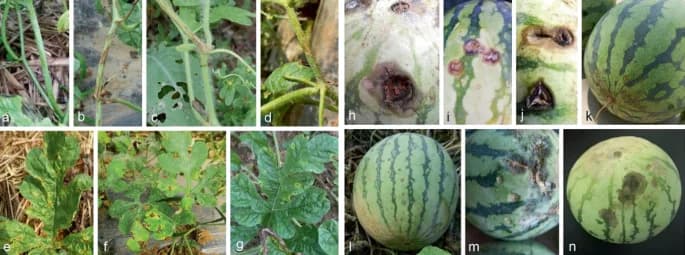
Anthracnose can attack watermelon leaves, stems, and fruits.
Symptoms on leaves
- Small brown spots.
- Spots may increase in size as the disease progresses.
- Affected parts of the leaves may dry out.
Symptoms on fruits
- Dark or brown spots.
- Affected areas may become sunken.
- Fruits may begin to rot.
- Fruit quality decreases.
Conditions that favor the disease
- Frequent rainfall.
- High humidity.
- Infected plant residues.
- Infected seeds.
Prevention
✓ Use quality seed from a reliable source.
✓ Remove infected plant residues.
✓ Practice crop rotation.
✓ Avoid unnecessary field operations when plants are very wet.
✓ Monitor for symptoms early.
4. FUSARIUM WILT
Fusarium wilt is associated with disease-causing organisms that can survive in the soil and affect the root system and the movement of water within the plant.
Symptoms
- Leaves wilting.
- Lower leaves turning yellow.
- Stunted plants.
- Weak growth.
- Severe infection may result in plant death.
Sometimes farmers may assume that the problem is simply a lack of water when they see plants wilting.
Prevention
✓ Use healthy seeds and seedlings.
✓ Practice crop rotation.
✓ Avoid moving soil from infected fields to healthy fields.
✓ Maintain good root and soil health.
✓ Use tolerant varieties where available.
5. PHYTOPHTHORA BLIGHT / FRUIT ROT
Phytophthora-related diseases can cause problems in roots, stems, and fruits, particularly under conditions of excessive moisture and poor drainage.
Symptoms
- Plants wilting.
- Root damage.
- Rotten areas developing on stems.
- Fruits in contact with wet soil beginning to rot.
- Fruits developing brown or water-soaked-looking areas.
Conditions that favor the problem
Excess water + poor drainage + high humidity = increased risk of rotting problems.
Prevention
✓ Improve field drainage.
✓ Avoid excessive irrigation.
✓ Prevent standing water in the field.
✓ Avoid allowing fruits to remain in excessively wet conditions.
✓ Practice crop rotation.
6. BACTERIAL FRUIT BLOTCH
Bacterial fruit blotch is a bacterial disease that can affect watermelon and other cucurbit crops.
Symptoms
The disease can affect:
- Leaves.
- Stems.
- Fruits.
Fruits may develop water-soaked areas or unusual lesions, and in severe cases fruit quality can be seriously affected.
Prevention
✓ Use seed from a reliable source.
✓ Avoid seed of uncertain health status.
✓ Maintain good sanitation of farm equipment.
✓ Avoid spreading infected plant residues.
✓ Monitor the crop for symptoms early.
For bacterial diseases, using pesticides without correctly identifying the problem may fail to solve the underlying issue.
7. VIRAL DISEASES OF WATERMELON
Watermelon can also be affected by viral diseases that influence plant growth, leaves, and fruits.
Symptoms
Symptoms may include:
- Leaves developing irregular light- and dark-green patterns.
- Leaf curling or distortion.
- Stunted plant growth.
- Weak vine development.
- Fruits developing abnormal shapes or appearance.
- Reduced fruit size and quality.
Some viruses can be transmitted by insects such as aphids and other insects that feed on plant sap.
Prevention
✓ Manage insect pests using an integrated pest-management approach.
✓ Use healthy seed and planting material.
✓ Remove severely affected plants using appropriate sanitation practices.
✓ Control weeds that may serve as hosts for certain pathogens or insect vectors.
✓ Monitor the field regularly.
8. DAMPING-OFF
Damping-off is mainly a problem during the nursery and early seedling stages.
Symptoms
- Seedlings suddenly become weak.
- The stem near the soil surface becomes thin.
- The stem may rot.
- Seedlings collapse.
- Young seedlings may die.
Conditions that can contribute
- Excessive watering.
- Poor drainage.
- Overcrowded seedlings.
- Poor nursery sanitation.
- Contaminated soil or equipment.
Prevention
✓ Use a clean nursery.
✓ Avoid excessive watering.
✓ Ensure good drainage.
✓ Use quality seed.
✓ Avoid overcrowding seedlings.
9. ROOT ROT
Healthy roots are essential for watermelon because the plant needs a strong root system to absorb water and nutrients.
Symptoms
- Stunted plants.
- Wilting leaves.
- Yellowing leaves.
- Weak plant growth.
- Discolored or rotting roots.
What can contribute to the problem?
- Excessive water.
- Poorly drained soil.
- Soil-borne pathogens.
- Root injury.
- Poor irrigation management.
Prevention
✓ Ensure good drainage.
✓ Prevent standing water.
✓ Avoid over-irrigation.
✓ Maintain good soil health.
✓ Practice crop rotation where appropriate.
10. POWDERY MILDEW AND DOWNY MILDEW ARE NOT THE SAME
It is important for farmers to distinguish between these two diseases.
Powdery mildew commonly appears as a white powdery growth on the surface of leaves.
Downy mildew often begins as yellow or pale-green spots on leaves and may later turn brown, particularly under humid conditions.
Because these diseases differ in their characteristics and environmental conditions, correct identification is important before selecting a management approach.
11. FRUIT ROT
Watermelon fruits can rot due to various pathogens or unfavorable environmental conditions.
Symptoms
- Spots on the fruit.
- Softening of affected areas.
- Rotting of the fruit.
- Loss of fruit quality.
- Disease continuing during transportation or after harvest.
Prevention
✓ Avoid damaging fruits.
✓ Prevent fruits from remaining in standing water.
✓ Manage excessive moisture.
✓ Remove affected fruits.
✓ Maintain good field sanitation.
WHY CAN WATERMELON DISEASES SPREAD QUICKLY?
Diseases can spread through different pathways, including:
- Rainfall.
- Irrigation water.
- Soil.
- Plant residues.
- Infected seed.
- Farm tools and equipment.
- Animals and human activities.
- Insect vectors that can transmit some viruses.
Therefore, farmers should manage the field as a complete production system, rather than focusing only on individual plants.
WHAT SHOULD A FARMER DO WHEN SYMPTOMS ARE DETECTED?
When unusual symptoms appear, farmers can take the following steps:
1. Do not immediately apply pesticides
First, identify the suspected problem.
2. Inspect the entire plant
Check the:
- Roots.
- Stem.
- Leaves.
- Flowers.
- Fruits.
3. Examine the soil
Check:
- Soil moisture.
- Drainage.
- Field history.
- Crops previously grown in the field.
4. Examine the environment
Ask:
- Has there been excessive rainfall?
- How much irrigation has been applied?
- Are plants overcrowded?
- Are insect pests present in large numbers?
5. Seek professional advice
Correct diagnosis can help reduce unnecessary pesticide use and production costs.
PREVENTION IS BETTER THAN WAITING FOR DISEASE TO SPREAD
Watermelon farmers are encouraged to use an integrated approach to disease and pest management.
This may include:
✓ Using quality and healthy seed.
✓ Selecting varieties suitable for local conditions.
✓ Practicing crop rotation.
✓ Maintaining good field sanitation.
✓ Controlling weeds.
✓ Managing insects that can transmit viruses.
✓ Managing irrigation properly.
✓ Improving drainage.
✓ Avoiding excessive plant crowding.
✓ Removing infected plants using appropriate management practices.
✓ Inspecting the field regularly.
✓ Using registered agricultural products that are appropriate for the identified problem.
MISTAKES WATERMELON FARMERS SHOULD AVOID
❌ Applying pesticides without knowing the possible cause of the problem.
❌ Assuming every wilting plant is suffering from lack of water.
❌ Over-irrigating the crop.
❌ Allowing water to stand in the field.
❌ Growing watermelon continuously without considering crop rotation.
❌ Leaving infected plant residues in the field.
❌ Using seed of uncertain health status.
❌ Mixing different pesticides without professional advice.
❌ Applying higher rates than recommended.
❌ Waiting until the disease has spread before seeking assistance.
CHETU AGROSOLUTION — HELPING FARMERS SOLVE WATERMELON PRODUCTION CHALLENGES
Are your watermelons:
Wilting?
Developing spots on the leaves?
Developing white powdery growth on the leaves?
Experiencing root rot?
Developing fruit rot?
Showing poor plant growth?
Producing poorly developed fruits?
Showing symptoms you cannot identify?
Do not wait until the problem becomes severe.
Visit CHETU AGROSOLUTION or contact us for assistance in identifying, managing, and solving challenges affecting your watermelon crop, together with advice on the appropriate use of agricultural inputs and crop-management practices.
We advise farmers on:
✓ Identification of disease symptoms
✓ Watermelon disease management
✓ Soil and root health
✓ Crop nutrition and fertilizer programs
✓ Insect pest management
✓ Disease prevention
✓ Selection of appropriate agricultural inputs
✓ Proper use of agricultural products
✓ Crop management according to the growth stage
DO NOT WAIT FOR LOSSES TO COME FIRST
Diseases can cause serious losses when they are left unmanaged or identified too late.
If you notice unusual symptoms on your watermelon plants, contact CHETU AGROSOLUTION early.
CHETU AGROSOLUTION
Agricultural Inputs • Professional Advice • Farming Solutions
Successful farming starts with correct identification, early prevention, and the right advice.